
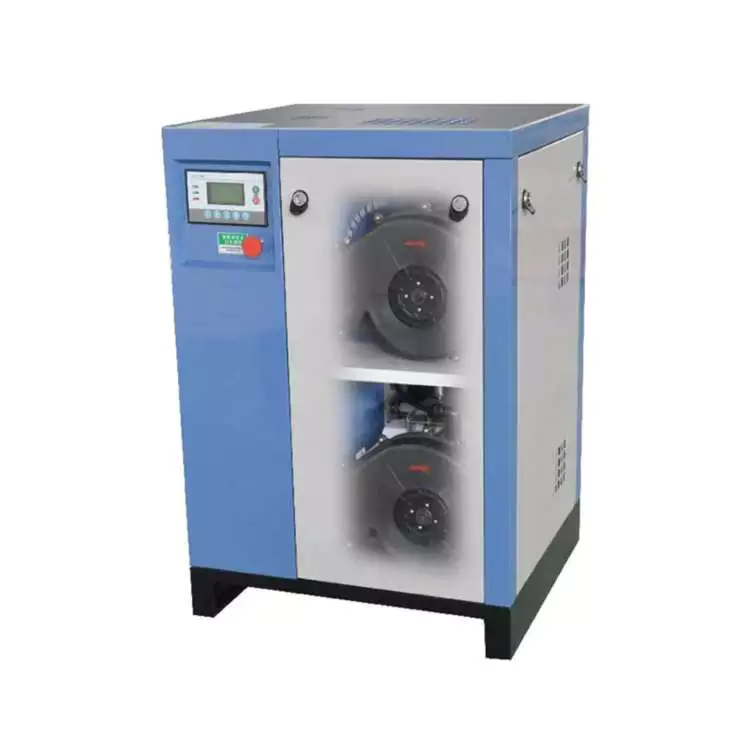
EP-CMW13.5-1.0 Oil-Free Scroll Air Compressor
The EP-CMW13.5-1.0 houses three 4.5 kW scroll heads in one intelligent cabinet to deliver 1230 L/min of certified oil-free air at 1.0 MPa — with three-stage demand management that cuts compressed air energy costs by matching head count precisely to production load, and two-level redundancy that keeps air flowing during any single-head maintenance event.
EP-CMW13.5-1.0: Why the Three-Head Architecture Changes Your Compressed Air Running Cost
Most compressed air system discussions start with maximum demand. This one starts with the gap between maximum demand and average demand -- because that gap is where energy is wasted. A facility that needs 1230 L/min during peak three-shift production rarely needs the same volume overnight, on weekends, or between production runs. A single large compressor running to cover peak demand burns the same electricity at 30% utilisation that it does at 100%. The EP-CMW13.5-1.0 is designed to close that gap.
Three 4.5 kW scroll air-ends in a single managed cabinet give this unit three distinct operating levels: 410 L/min on one head, 820 L/min on two, or the full 1230 L/min on all three -- each at up to 1.0 MPa. The touch-screen PLC selects the appropriate level automatically in response to real-time system pressure, transitioning between stages without operator input. For facilities with variable shift patterns, seasonal demand cycles, or mixed production schedules, this three-stage response is not a convenience feature -- it is the mechanism by which compressed air electricity consumption tracks actual production activity rather than running ahead of it. Compare all output levels across the full EP-CMW 1.0 MPa range.
The Three-Stage Demand Response: What It Means for Your Energy Bill
Consider a pharmaceutical facility with this demand profile: overnight (10 pm to 6 am) building services and HVAC pneumatics draw roughly 380 L/min. Single-shift granulation and tablet press operations (6 am to 2 pm) consume around 790 L/min. Peak double-shift production including packaging and coating (2 pm to 10 pm) reaches 1180 L/min. A conventional single large compressor sized for peak demand runs at approximately 31% capacity overnight, 64% during single-shift, and near full load in the evening. Across a 24-hour cycle, it consumes power roughly proportional to its rated output regardless of actual demand.
EP-CMW13.5-1.0 Three-Stage Response in This Scenario
Overnight: one head at 410 L/min (4.5 kW consumed). Single-shift: two heads at 820 L/min (9 kW consumed). Peak production: all three heads at 1230 L/min (13.5 kW consumed). The compressor draws only the power its current production stage requires.
The practical energy saving varies with the actual demand profile of your facility. Plants with significant off-peak periods -- common in food manufacturing, pharmaceutical production, and multi-shift industrial coating -- consistently report that three-stage demand management reduces compressed air electricity consumption by 25 to 40 percent compared to running a single fixed-speed machine sized for peak demand. That saving compounds over the equipment lifetime. At industrial electricity tariffs common in the EU and Australia, a 30% reduction on 13.5 kW of compressor power across an 8,000-hour annual operating period represents a substantial contribution to the total cost of ownership calculation.
This is also where the 1.0 MPa working pressure adds further value. At 0.8 MPa, facilities often oversize their compressor to ensure adequate pressure headroom at peak demand. At 1.0 MPa working pressure, the EP-CMW13.5-1.0 provides 0.2 MPa of headroom above standard 0.8 MPa-rated equipment -- meaning downstream regulators can be set accurately without approaching the supply pressure ceiling, and pressure consistency is maintained even as the PLC transitions between one, two, and three heads.
Two Levels of Built-In Redundancy: Rethinking Maintenance Downtime
Most compressed air maintenance discussions frame the question as: when does the compressor stop? With the EP-CMW13.5-1.0, the question becomes: which head is being serviced today, and what is the remaining capacity? With three heads, the unit maintains two active heads -- 820 L/min at 1.0 MPa -- while the third undergoes maintenance. For most industrial facilities, 820 L/min covers off-peak and single-shift production without any process adjustment. This is a structural change in how compressed air maintenance is planned and resourced.
Maintenance Window Planning with Three Heads
Head A under service (one working day): Heads B and C deliver 820 L/min -- sufficient for single-shift and most double-shift operations. Production schedule adjustments: typically none for off-peak maintenance windows. Maximum maintenance-related capacity reduction: 33% (not 100%).
The PLC touch-screen tracks cumulative running hours for each of the three heads independently and displays individual maintenance reminders on separate indicators. Because the automatic lead rotation algorithm cycles each head through primary, secondary, and standby roles over time, all three heads approach their maintenance intervals simultaneously -- simplifying the service planning into predictable, evenly spaced events rather than staggered, unpredictable individual head failures.
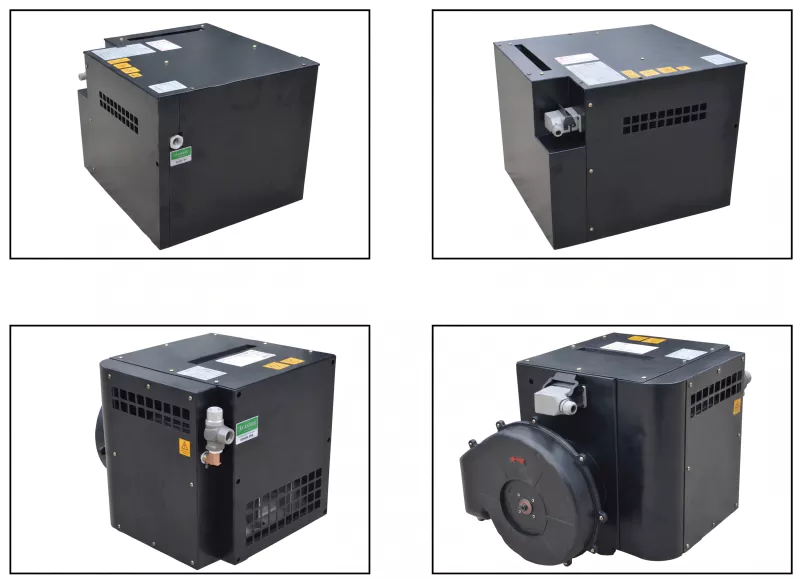
1.0 MPa at 1230 L/min: The Technical Case for Higher Pressure at Scale
Scaling compressed air volume while maintaining 1.0 MPa working pressure requires more than simply connecting larger motors. The compression ratio at 1.0 MPa is meaningfully higher than at 0.8 MPa, and scroll head efficiency at this ratio depends on the precision of the scroll geometry, the quality of the tip seal material, and the stiffness of the housing that maintains scroll profile tolerances under thermal and mechanical cycling. Each of the three 4.5 kW scroll heads in the EP-CMW13.5-1.0 uses scroll profiles and tip seal specifications developed for 1.0 MPa continuous service -- not adapted from 0.8 MPa geometry with increased motor power added to compensate.
This matters most at the extremes of the operating envelope: when ambient temperature is high, when the compressor has been running for extended hours, and when all three heads are operating simultaneously at full load. The high-stiffness square air-end housing -- the same design that enabled Ever Power to achieve the world's first 1.2 MPa oil-free scroll compressor -- maintains scroll geometry integrity under these conditions, preserving volumetric efficiency and the 1230 L/min rated output at 1.0 MPa across the full operating range. All three air-ends carry a 2-year warranty.
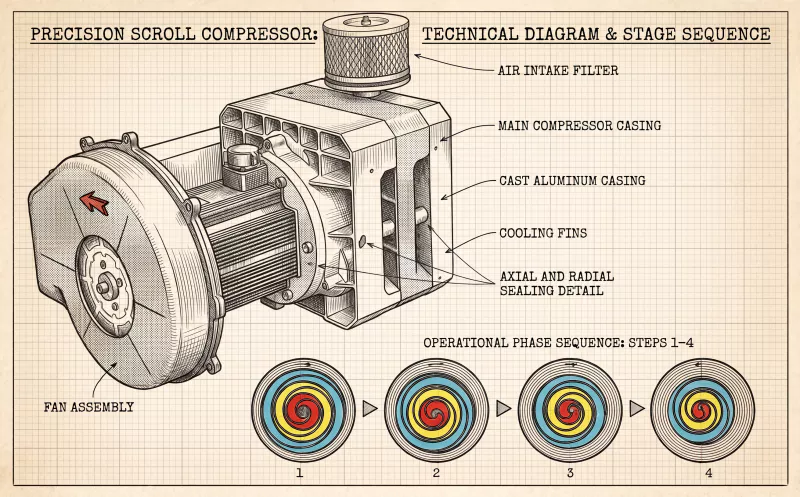
The compression cycle in each head follows the same orbital scroll mechanics across the CMW range. Air enters at the scroll periphery and is sealed into crescent-shaped pockets between the fixed and orbiting scrolls. As the orbiting scroll traces its circular path, these pockets travel inward through a longer compression path than in 0.8 MPa models -- the additional path length achieves the higher compression ratio needed for 1.0 MPa output without increasing scroll head size. Three heads discharge simultaneously into a common stainless steel manifold, producing a combined 1230 L/min of oil-free, pulse-free air at the 1-inch stainless outlet.
Where the EP-CMW13.5-1.0 Is the Right Answer -- and Where It Is Not
High-capacity oil-free scroll compressors are not the right answer for every application. This section maps the EP-CMW13.5-1.0 against the three application profiles where it consistently delivers the best outcome, and identifies the configurations where a different EP-CMW model would be more appropriate.
Best Fit: Multi-Shift Facilities with Variable Demand
Pharmaceutical, food, and industrial manufacturing operations running two or three shifts with meaningfully different air demand between shifts gain the most from three-stage demand management. The energy saving in low-demand periods accumulates across the operating lifetime and materially improves total cost of ownership against a single large compressor.
Best Fit: Processes Where Downtime Has a Direct Cost
Continuous coating lines, aseptic filling, GMP pharmaceutical production, and automated assembly operations where a compressed air stop triggers a batch rejection, line restart cost, or regulatory non-conformance benefit most from the two-level redundancy of three-head architecture. Maintenance becomes a scheduled activity rather than an unscheduled event.
Best Fit: Facilities That Have Grown Beyond a Single Oil-Free Unit
Laboratories and production sites that started with one or two small oil-free compressors and have expanded to the point where multiple machines are creating coordination complexity -- staggered maintenance, separate electrical connections, inconsistent pressure at peak combined demand -- find that consolidating into one EP-CMW13.5-1.0 simplifies operations significantly.
Consider Instead: Constant High-Demand Processes
Facilities running at or near maximum air demand continuously with little variation between shifts gain less from three-stage management. If your peak demand is consistently above 1100 L/min and rarely drops below 900 L/min, the EP-CMW18-1.0 (1640 L/min, four heads) may be the more appropriate choice for capacity headroom.
Consider Instead: Lower-Volume Applications
If your 1.0 MPa demand is consistently below 800 L/min, the EP-CMW9-1.0 (820 L/min, dual-head) provides two-stage demand management at a smaller footprint and lower capital cost.
Technical Specifications
| Parameter | Specification |
|---|---|
| Model | EP-CMW13.5-1.0 |
| Configuration | Triple Air-End (3 x 4.5 kW scroll heads) |
| Total Motor Power | 13.5 kW / 18 HP |
| Working Pressure Range | 0.2 - 1.0 MPa |
| Free Air Delivery (FAD) | 1230 L/min (at rated 1.0 MPa) |
| Capacity Steps | 410 / 820 / 1230 L/min (1 / 2 / 3 heads) |
| Noise Level | 61 +/- 3 dB(A) |
| Outlet Connection | 1 inch stainless steel |
| Weight | 300 kg |
| Dimensions L x W x H | 1450 x 900 x 1150 mm |
| Air-End Warranty | 2 Years per head |
| Motor Type | Permanent Magnet x3, IP65, F-class, >94% efficiency each |
| Drive | Direct Drive per head (no belt, no coupling) |
| Control | Touch-screen PLC: 3-stage demand, auto head rotation, per-head maintenance reminders |
| Air-Contact Surfaces | Stainless Steel throughout |
| Inlet Filtration | 1 micron per head (independent) |
| Lubrication | Oil-Free -- annual bearing grease per head only |
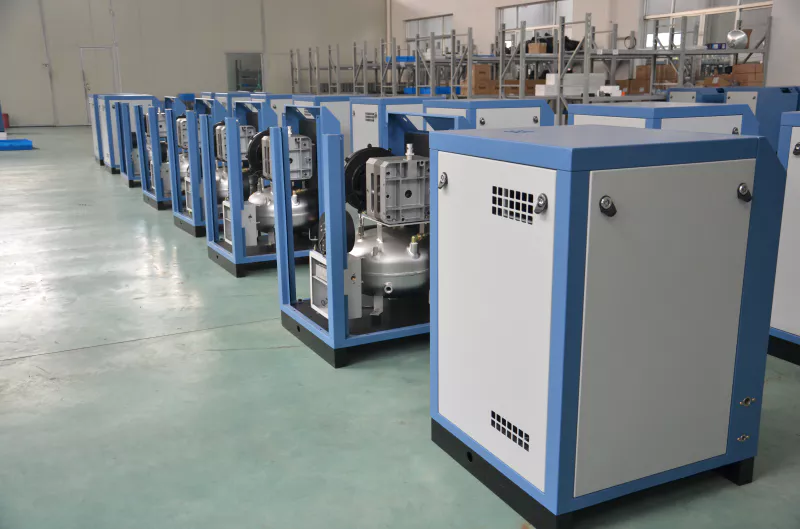
Customer Case Studies
France -- Pharmaceutical Oral Solid Dosage Facility
Three-Stage Demand Management Reduced Compressed Air Energy by 34%
A French pharmaceutical manufacturer producing film-coated tablets and hard capsules across three production suites ran an energy audit that identified their compressed air system as the second-largest electricity consumer on site. Their existing setup -- two separate 7.5 kW oil-free rotary screw compressors running in lead/lag mode -- consumed near-constant electricity because the lag compressor started frequently to cover short demand peaks, then idled at partial load. Replacing both units with the EP-CMW13.5-1.0 gave their energy manager a three-step capacity response that matched the facility's distinct overnight, single-shift, and peak-production demand periods. Electricity consumption from compressed air fell by 34% in the first full year of operation. GMP qualification of the new system was straightforward because the oil-free output eliminated the compressed air oil content test from the validation protocol entirely.
★★★★★
"34% energy reduction in year one. The auditor's report identified this as the single largest energy saving available on site. GMP qualification took half the time because we removed oil content from the protocol." -- Site Energy Manager
Australia -- Multi-Line Food Processing Campus
Consolidating Three Separate Compressors Into One Managed System
A food processing site near Melbourne producing snack foods, sauces, and ready meals across three adjacent buildings had accumulated three separate oil-free compressors over successive expansion phases -- each sized for its building's peak demand, each on a separate maintenance schedule, and none coordinated with the others. During production peaks, all three ran simultaneously and were still occasionally short on pressure. During quiet periods, all three idled. The facilities team replaced all three with a single EP-CMW13.5-1.0 connected to a ring main serving all three buildings. Peak demand was comfortably met by all three heads at 1230 L/min. Off-peak demand was handled by one or two heads. The maintenance schedule went from three independent service records to one three-head unit with staggered per-head reminders from the PLC. BRC audit result: clean pass with specific commendation on compressed air system organisation.
★★★★★
"Three compressors, three maintenance schedules, still short on pressure sometimes. Now one unit, one schedule, and we've never been short since. BRC auditor actually commented on how clean the system was." -- Facilities Director
Colombia -- Industrial Coating Plant for Automotive Parts
Eliminating Pressure Sag During Shift Changeover Peak Demand
An automotive components coating plant in Medellin had a specific problem: during the 20-minute window when both production shifts were simultaneously active -- the outgoing shift completing last batches while the incoming shift started equipment warm-up -- compressed air demand spiked well above their installed capacity. Their two existing compressors could not handle this overlap window, causing pressure sag that affected atomisation quality on finishing coats. The EP-CMW13.5-1.0's 1230 L/min capacity at 1.0 MPa absorbed the changeover peak without pressure variation. Outside the peak window, two heads handled normal production, and the energy saving from single-head overnight operation more than offset the additional capital cost within the first 14 months.
★★★★★
"The changeover pressure sag that was ruining our finishing coats is gone. Two heads run during production, one overnight. The energy saving made the ROI calculation simple." -- Plant Engineering Manager
Frequently Asked Questions -- EP-CMW13.5-1.0
How does three-stage demand management actually reduce electricity consumption?
At any moment the PLC is running only the heads needed to maintain system pressure within the set band. One head at 4.5 kW handles low-demand periods; two heads at 9 kW cover medium demand; all three at 13.5 kW serve peak production. A conventional single large compressor sized for 13.5 kW peak demand draws power proportional to its full rated capacity regardless of actual demand at any given moment. The difference -- especially across overnight and weekend periods in multi-shift facilities -- accumulates into a significant annual energy saving.
What is the minimum air volume available if one head is under maintenance?
With one head under scheduled maintenance and two heads operating, the unit delivers 820 L/min at 1.0 MPa -- equivalent to the full output of the dual-head EP-CMW9-1.0. For most multi-shift facilities, this volume is sufficient to maintain single-shift and off-peak production without process adjustment, meaning head maintenance can be scheduled during lower-demand shifts without any production impact.
How does the PLC manage the transition between one, two, and three heads?
The PLC monitors downstream system pressure continuously at a high update frequency. When pressure falls below the two-head activation threshold, the second head starts after a brief delay (to avoid simultaneous inrush current). When pressure falls further to the three-head threshold, the third head starts with the same delay. As demand drops and pressure recovers above the deactivation setpoints, heads are stopped in sequence. All transitions are automatic and silent -- no alarms, no operator notification unless a fault condition occurs.
Can the three capacity setpoints be adjusted for our specific demand profile?
The pressure setpoints that trigger head start and stop events are configurable within the PLC settings. Ever Power's commissioning team sets initial values based on the application's specified working pressure, and these can be adjusted by authorised personnel using the touch-screen interface. This allows the system to be optimised for facilities with unusual demand profiles or tight pressure tolerance requirements.
How does this unit compare to a variable speed drive rotary screw compressor at similar capacity?
A VSD rotary screw compressor of equivalent oil-free output requires either dry-screw or water-injected technology, both with substantially higher maintenance requirements than scroll compression. The EP-CMW13.5-1.0's three-head architecture achieves a similar demand-tracking result to VSD control -- but through head staging rather than motor speed variation -- while operating at lower noise, without oil management complexity, and with individual head redundancy that a single VSD screw unit cannot provide.
The Total Cost of Ownership Conversation
Compressed air equipment decisions are rarely made on purchase price alone -- but the running cost component of that decision is often underweighted because it requires assumptions about future demand patterns and energy tariffs. The EP-CMW13.5-1.0 makes that calculation more favourable in two ways: three-stage demand management directly reduces electricity consumption in proportion to the gap between your peak and average demand, and two-level maintenance redundancy reduces the cost of unplanned downtime to near zero. For facilities where compressed air is a significant operational cost, both components deserve quantification before selecting a system.
Ever Power's engineering team can assist with application sizing, energy consumption estimates based on your demand profile, and configuration guidance for both standard and custom installations. Learn more about Ever Power's engineering and manufacturing background, or review the full EP-CMW product range to compare capacity and pressure options.
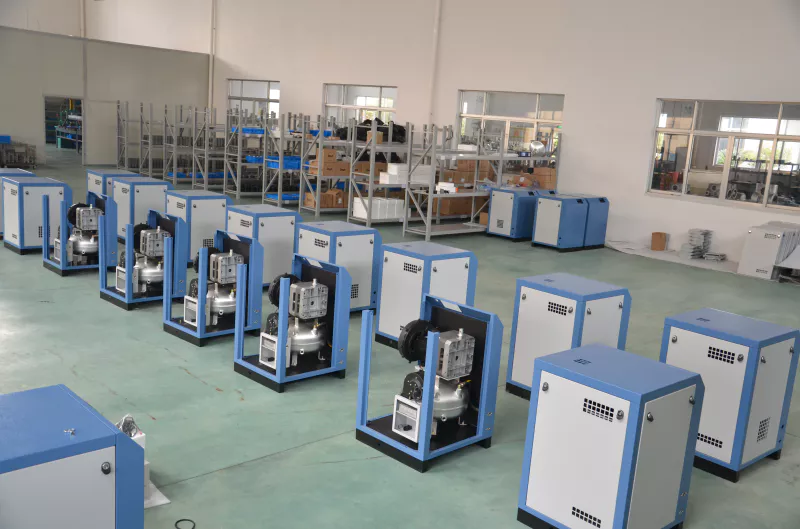
Factory tour


Related Products
-
CM/PV permanent magnet variable frequency oil-free screw air compressor
-
CM/PV permanent magnet variable frequency oil-free screw air compressor
-
CM/GPV medium pressure permanent magnet variable frequency oil-free screw air compressor
-
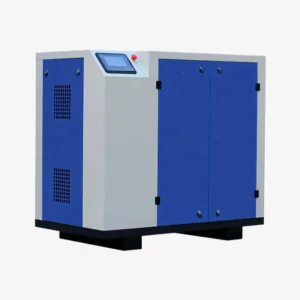
CM/G medium pressure industrial frequency oil-free screw air compressor