
When a PET bottle blowing operation commits to oil-free compressed air technology — and in food, beverage, and pharmaceutical packaging the case for that commitment is compelling — the next specification decision is the choice of oil-free technology type. Two distinct engineering approaches exist: water-lubricated oil-free screw compressors, which use pure water as the lubrication, sealing, and cooling medium inside the compression chamber; and dry oil-free screw compressors, which use no liquid medium at all in the compression process, relying instead on precision rotor clearances and PTFE or other anti-friction coatings to achieve contact-free compression. Both approaches produce compressed air with zero oil contamination. The differences between them in pressure capability, energy efficiency, service life, thermal behaviour, and maintenance profile are significant — and they directly affect the suitability of each technology for the specific demands of PET bottle blowing at 30–40 bar.
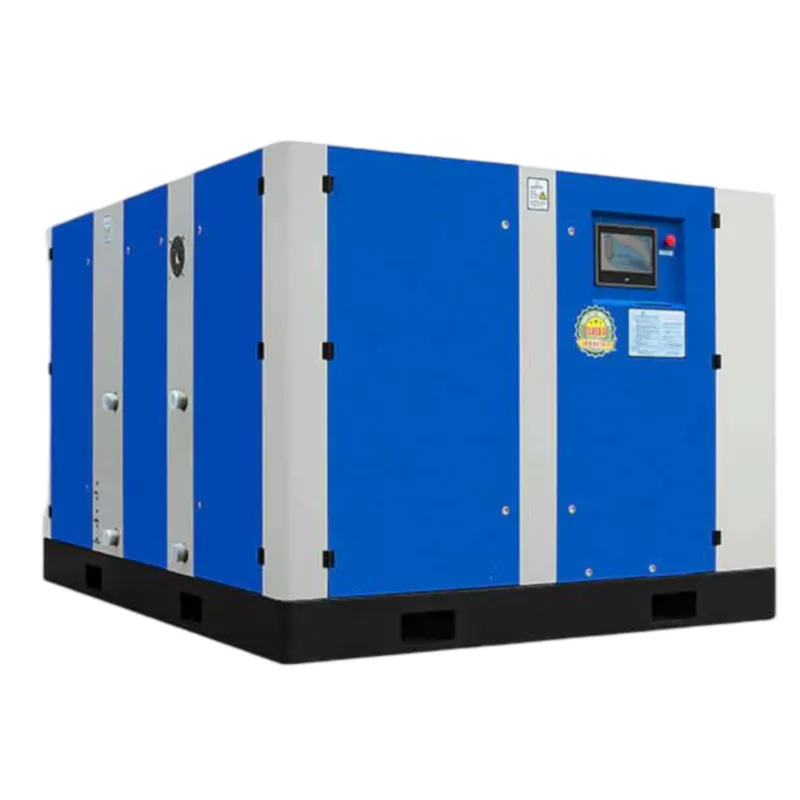
The Fundamental Mechanical Difference
In a dry oil-free twin-screw compressor, the two counter-rotating rotors are precision-machined to maintain a small clearance between them and between the rotors and the housing. No liquid medium is present in the compression chamber during operation. The clearances are small enough to achieve reasonable volumetric efficiency, but large enough to prevent rotor contact — which would cause catastrophic damage without lubrication. Timing gears external to the compression chamber synchronise the rotors. The rotors are coated with PTFE, special polymers, or other anti-friction materials to protect against incidental contact during startup and thermal transients. The compression process is adiabatic — no cooling occurs within the compression chamber — and the discharge temperature at the design pressure ratio is typically 150–200°C.
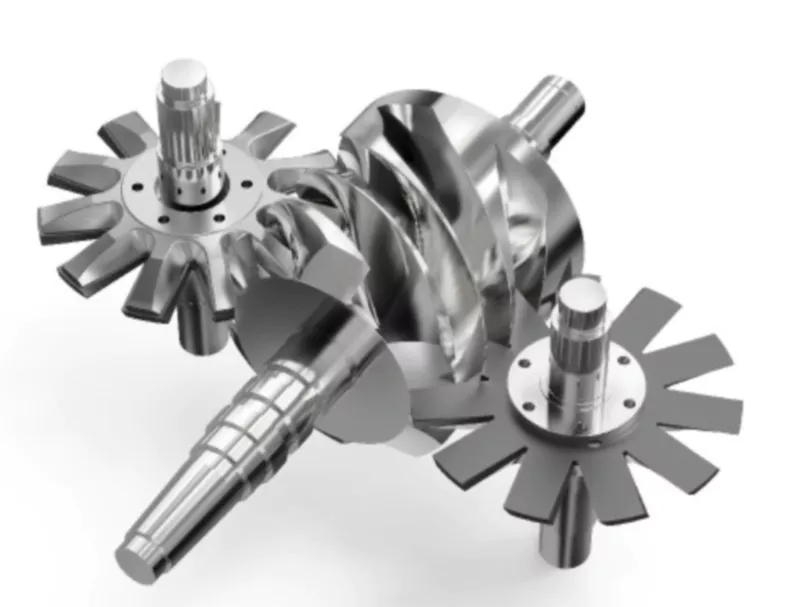
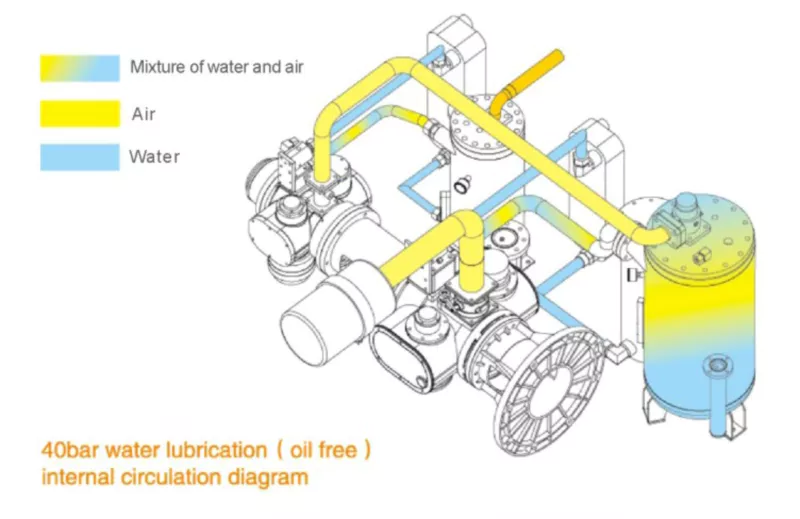
In a water-lubricated single-screw compressor, pure water is injected directly into the compression chamber throughout the operating cycle. The water fills the clearance between the screw and the star wheel contact surfaces, providing lubrication that prevents wear. It seals the clearances between the screw and the housing, increasing volumetric efficiency beyond what dry clearance designs can achieve. It absorbs compression heat continuously, maintaining the compression chamber at only 15°C above ambient — near-isothermal conditions. And it carries that heat away through the plate heat exchanger and back to the cooling circuit, maintaining stable thermal conditions at any operating point within the rated pressure and flow range.
Maximum Working Pressure
This is the most immediately relevant difference for PET bottle blowing applications. Standard dry oil-free twin-screw compressors are designed for working pressures in the range of 7–13 bar. Reaching PET blowing pressures of 30–40 bar with dry twin-screw technology requires a two-stage configuration with an intermediate cooling stage — a fundamentally more complex system than a single-stage machine, with the associated intercooling infrastructure, additional maintenance points, and stage-boundary energy losses.
Water-lubricated single-screw compressors achieve 40 bar in a single compression stage. The water sealing of compression clearances at high pressure ratios is the enabling mechanism — water maintains volumetric efficiency and seals against backflow at pressure differentials that would cause unacceptable leakage in a dry clearance design. This single-stage 40-bar capability is the characteristic most directly relevant to PET bottle blowing, and it is why water-lubricated technology dominates in new PET blowing compressed air installations globally.
| Characteristic | Water-Lubricated Single Screw | Dry Oil-Free Twin Screw |
|---|---|---|
| Single-stage max pressure | Up to 4.0 MPa (40 bar) | ~0.8–1.3 MPa (8–13 bar) |
| To reach 40 bar for PET blowing | Single stage, no intercooler | Two stages + intercooling required |
| Compression chamber temperature | Ambient + 15°C | 150–200°C (adiabatic) |
| Air end rotational speed | ~3,000 rpm | 6,000–25,000 rpm |
| Number of compression air ends | 1 (single screw) | 2 (for 40 bar) |
| Number of gears | 0 | 5–7 (timing + speed-up gears) |
| Number of bearings | 7 | >15 |
| Shaft seals | Patented no-shaft-seal design | >15 seals |
| Rotor coating requirement | None (water seals and lubricates) | PTFE or polymer coating required |
| Design service life | >25 years | 10–15 years typical |
Energy Efficiency: Isothermal vs Adiabatic Compression
The thermodynamic difference between water-lubricated and dry oil-free compression is substantial. In an adiabatic (dry) compression process, the work done to compress the gas increases with the temperature of the gas — the hotter the gas becomes during compression, the more energy is required to continue compressing it. At 40 bar, an adiabatic process requires significantly more energy than an isothermal process producing the same final state.
Water lubrication achieves near-isothermal compression because the water absorbs heat continuously throughout the compression process. The temperature rise is limited to 15°C above ambient regardless of the pressure ratio — the water’s thermal capacity is sufficient to absorb the heat of compression at the rate it is generated, maintaining near-constant temperature throughout the cycle. This reduces the theoretical minimum energy required to reach 40 bar by more than 10% compared to the adiabatic case — a saving that is realised in practice in the compressor’s specific power consumption (kW per m³/min of output).
For PET blowing operations running 8,000 hours per year at 100–300 kW, a 10% energy efficiency advantage translates to a meaningful annual electricity cost reduction — and over a 25-year service life, this cumulative advantage significantly outweighs the higher initial purchase price of water-lubricated technology.
Discharge Temperature and Its Consequences
The discharge air temperature from a water-lubricated compressor is typically 45–55°C — close to ambient, because the isothermal compression process limits temperature rise throughout. The discharge temperature from a dry oil-free twin-screw compressor at equivalent pressure may be 150–200°C before the aftercooler, and 40–60°C after the aftercooler at the system outlet.
The practical consequence of lower discharge temperature in a water-lubricated system is a dramatically lower moisture load on downstream drying equipment. Compressed air at 55°C discharge temperature carries significantly less moisture than air at 200°C before aftercooling — meaning the refrigerated or desiccant dryer in a water-lubricated system handles a lower absolute moisture load per unit time, extending desiccant service intervals and reducing dryer energy consumption. This is a secondary energy efficiency advantage that is frequently overlooked in compressor selection analyses.
Maintenance Profiles: What Each Technology Requires
The maintenance requirements of the two technologies reflect their mechanical complexity. Dry oil-free twin-screw compressors for 40-bar PET blowing applications — typically two-stage configurations — have more than 15 bearings, 5–7 timing and speed-up gears, multiple shaft seals, rotor coatings that degrade over time, and two compression stage housings that each require periodic inspection. The rotor coatings in dry oil-free designs are wear items — they protect against incidental contact during transient operating conditions, but they do degrade over the compressor’s service life, and their condition affects both volumetric efficiency and the risk of rotor contact.
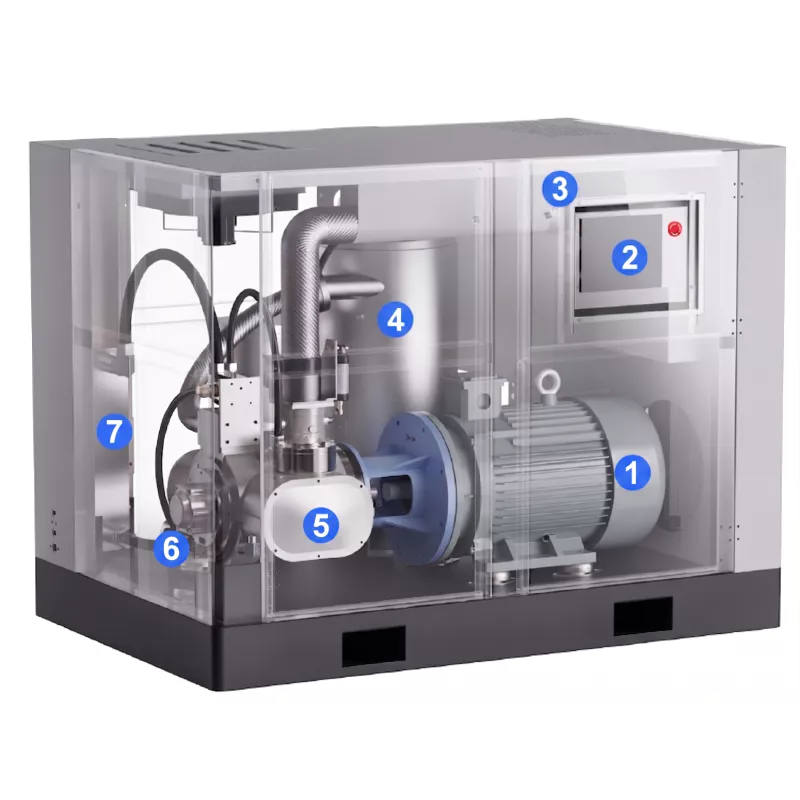
Water-lubricated single-screw compressors have 7 bearings, no gears, no rotor coatings, and a patented no-shaft-sealing design that eliminates shaft seals entirely. Daily consumables are the air intake filter element and the water filter element — both low-cost, quick-change items. The star wheel blades, manufactured from aviation-grade composite materials, require service only at multi-year intervals. Annual maintenance consists of a bearing grease check and filter element replacement. There is no rotor coating degradation mechanism, no gear wear inspection, and no multi-stage seal replacement schedule.
Hot Climate Performance
For PET blowing operations in tropical, subtropical, or desert climates — Southeast Asia, the Middle East, sub-Saharan Africa, South America — ambient temperature is a performance variable that affects compressor selection. Dry oil-free twin-screw compressors operating in 40°C+ ambient conditions face elevated bearing temperatures, increased rotor thermal expansion (affecting the precision clearances that prevent contact), and reduced aftercooler effectiveness. Some designs require ambient temperature derating above 40°C, reducing rated output in the climates where large PET blowing markets are growing fastest.
Water-lubricated compressors are substantially less sensitive to ambient temperature. Because the compression chamber temperature is locked to ambient +15°C by the water cooling effect, the compression process temperature at 40°C ambient (55°C chamber temperature) is nearly identical to operation at 25°C ambient (40°C chamber temperature). The thermal stability of the water lubrication mechanism provides consistent performance and consistent oil-free air quality regardless of ambient conditions — an advantage that becomes operationally critical in hot climates.
Which Technology Is Right for PET Bottle Blowing?
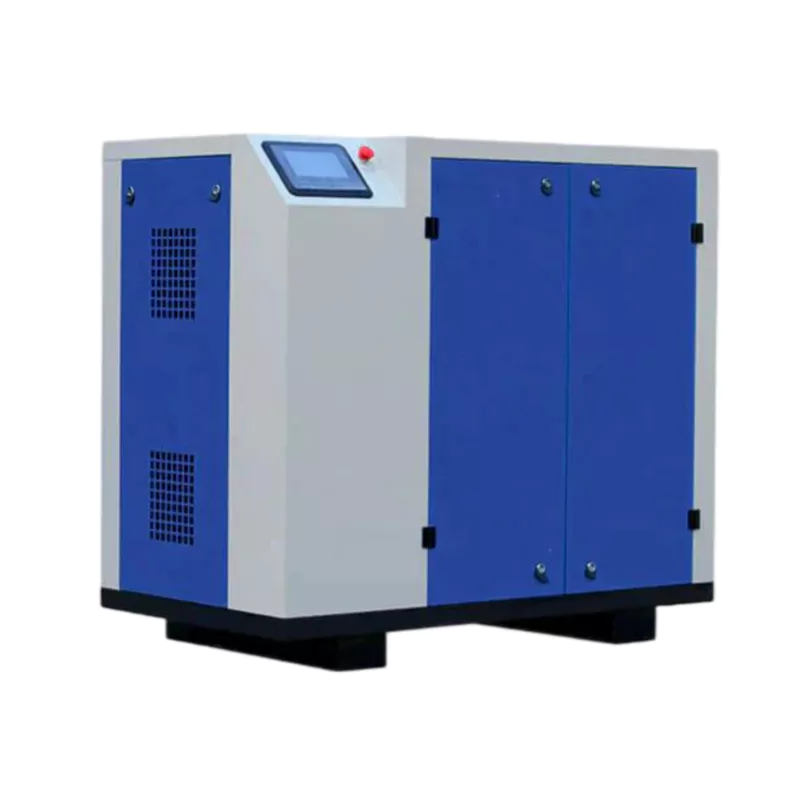
For PET bottle blowing applications at 30–40 bar, the water-lubricated single-screw compressor is the preferred technology across all the dimensions that matter for this application. It achieves the required pressure in a single stage without intercooling infrastructure. It delivers 10%+ energy efficiency advantage through isothermal compression. It produces structurally guaranteed Class 0 oil-free air without rotor coating degradation mechanisms. Its simpler mechanical design — 7 bearings, no gears, no shaft seals, no rotor coatings — has fewer maintenance requirements and a longer design service life. And its thermal stability makes it equally suitable for tropical and temperate climates without derating.
Dry oil-free twin-screw technology retains strong competitiveness in standard industrial pressure applications (7–13 bar) where two-stage compression to 40 bar is not required and where the large installed base and mature supply chain for dry twin-screw designs provides commercial advantages. For PET bottle blowing specifically — where 40 bar single-stage capability, Class 0 oil-free air quality, energy efficiency at high pressure ratios, and long service life in demanding environments are the primary requirements — water-lubricated single-screw technology addresses each requirement more directly than the dry oil-free alternative.